
Anyone looking for a keyword research tool will quickly notice that there are quite a few different SEO and keyword research tools available.
Most of them rely on backlink metrics like DR, DA (Domain Authority), and keyword difficulty. However, LowFruits takes a different approach. That’s why I want to share my LowFruits experience with you here.
This keyword tool uses alternative methods, allowing you to discover different kinds of keywords. Yes, most of them are long-tail keywords, but not only.
Let’s take a closer look at this SEO tool.
LowFruits Features of the Keyword Research Tool
To find suitable keywords, many people rely on keyword research and get numerous keyword ideas they can use to generate traffic, if they rank for them.
But what features does it offer, and how do you approach keyword analysis with this tool? Competitor analysis can also be done differently with this tool. Let’s take a closer look at its keyword research features.
You can generate a wide range of keywords by simply entering your main keyword. The results can either be exported entirely or you can select specific keywords.
You can also use wildcards to generate additional keywords, especially long-tail ones. You can then include these in your blog articles to increase visibility, even if they are smaller keywords with fewer clicks.
However, you’ll be able to cover a wide range of topics around your niche, helping you and your website build authority.
Here you can test the tool for free by yourself.
A Slightly Different Approach with This Keyword Research Tool
Most SEO tools rely on metrics like search volume, trend, cost per click (CPC), and other backlink-related data, whether it’s Surfer SEO, SemRush, SE Ranking, KWFinder by Mangools, etc.
LowFruits, however, shows you different search terms and keyword suggestions. The tool seems to have a very large data base, allowing you to generate a wide range of keyword ideas.
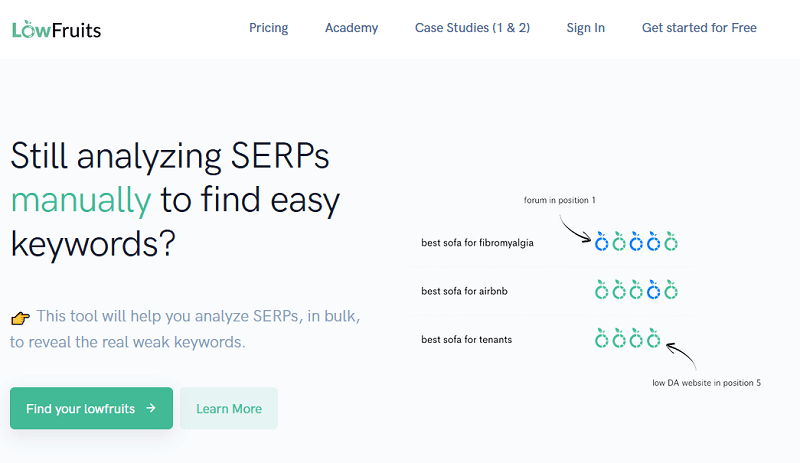
Simply enter your main keyword, and the software starts analyzing the competition. It specifically looks for weaknesses in competitors based on SERP analysis.
You’ll then receive the results and can create keyword lists accordingly.
You can also select keywords that reveal these gaps and optimize your content for them.
Of course, it’s important that the keywords are relevant.
The tool analyzes search results and identifies where platforms like Q&A sites or forums are ranking. Additionally, if you add your own website, it checks for pages with a lower or similar DA compared to yours.
This way, it uncovers “weak spots” in the SERPs that you can take advantage of, really powerful.
With the right keywords, it becomes much easier to achieve strong rankings and generate organic traffic through search queries.
You can also use wildcards to discover new keywords.
Here you can test the tool for free by yourself.
Performing SEO Keyword Research
To conduct keyword research with this tool, you proceed similarly to other tools. However, keep in mind that this one uses a credit-based system.
You should also think in advance about what makes sense, or use wildcards to generate new keyword ideas.
You can then go deeper step by step to generate more keywords. You can also enter a phrase and get suggestions based on it.
All the keywords generated by the tool can be used for your content planning.
Or you can use them to expand your existing content and achieve better rankings.
LowFruits Experience & Reviews
This keyword research tool is relatively easy to use. Many tools tend to become very complex over time. Since this one focuses “only” on keyword research, both the tool and its interface remain quite clean and simple.
The keyword generator, which provides numerous suggestions, can do even more. For example, you can group these keywords into multiple articles.
To do this, you can use different tools such as SurferSEO or even ChatGPT.
With an AI text generator, you can leverage these keyword suggestions to create blog articles.
Ranking for the “low-hanging fruits” found by LowFruits will actually be easier to optimize, allowing you to outperform your competitors.
Large companies often ignore these smaller keywords, making it harder for them to compete with you in that space.
Additionally, long-tail keywords can sometimes deliver higher click-through rates, meaning you can generate more revenue even with lower traffic.
That’s why my experience with this tool has been positive so far, the approach is very interesting.
Here you can test the tool for free by yourself.
LowFruits Pricing and Costs
The software mainly offers two different options. You can either purchase credits, meaning there is no subscription and nothing you have to pay monthly.
You buy these credits once and can then use them for a certain number of queries.
Alternatively, you can choose the monthly subscription.
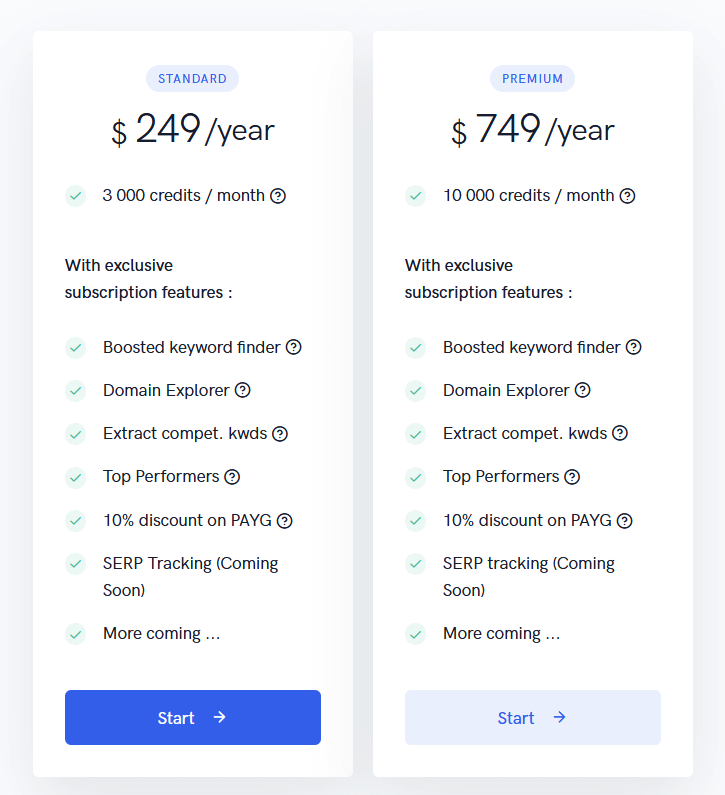
The Standard plan costs 29 US dollars per month and includes 3,000 credits per month.
There is also a Premium plan for 79 US dollars per month with 10,000 credits per month.
It depends on how many keyword research and analysis tasks you want to perform each month.
Here you can test the tool for free by yourself.
LowFruits Experience: Conclusion
Let’s wrap up my LowFruits experience. The tool is really powerful and outperforms many others. Its approach is different and helps you find search terms much more easily that are simpler to rank for.
It significantly simplifies keyword research and goes beyond just relying on autocomplete. You can start with the Basic or Standard plan and upgrade to Premium if you need more.
The bottom line: it’s a very useful and exciting tool that can uncover real golden nuggets from billions of keywords.
The biggest advantage is that you might even rank with your landing page by targeting these “low-hanging fruit” keywords.
Here you can test the tool for free by yourself.
FAQ
LowFruits vs. Surfer SEO?
You can’t really compare both SEO tools directly. SurferSEO* is more focused on keyword research and content creation, while LowFruits is designed purely for keyword research.
LowFruits vs. KWFinder?
Both are very solid and good tools with different approaches. However, I would probably choose this tool because of its approach.
If you’re doing a large number of keyword research tasks, then KWFinder might be better, and you can refine the results with LowFruits.
LowFruits vs. Ahrefs?
A direct comparison is also difficult here, since Ahrefs can do much more than LowFruits. However, when it comes to keyword research, this tool is ahead.
Here you can test the tool for free by yourself.